
Eric Lee/Getty Images
- President Donald Trump's tax bill may lead to larger refunds for many Americans in 2026.
- New deductions and increased child tax credits primarily benefit middle-income filers this year.
- IRS withholding changes for 2026 mean future paychecks will reflect the updated tax laws.
If you've been dreading filing your taxes, there might be a pleasant surprise awaiting you on the other end: a larger-than-usual refund.
President Donald Trump's "Big Beautiful Bill," which passed in July, aimed to overhaul Americans' taxes by extending 2017 tax cuts and enacting a slew of new measures. Those include new deductions for Social Security benefits to older Americans, an increase in the child tax credit, and deductions for taxes on tips or overtime.
But your paycheck probably hasn't reflected those changes yet. Right now, your employer might be withholding more taxes from your paycheck than you're required to pay, since the IRS opted not to change withholding this year as they phase in the new law. If that's the case, that extra money withheld could be coming back to you as a bigger refund after you file.
"Instead of your employer adjusting how much tax they withhold from your paycheck to reflect this new tax law for 2025, you'll have to get the benefit of those tax changes when you file your tax return in 2026," Erica York, the vice president of federal tax policy at the Tax Foundation, said. "Most people have overwithheld their taxes to some extent."
The Tax Foundation estimates that the average tax refund will grow from $3,052 in 2024 to $3,800 for tax year 2025. Depending on your income and circumstances, you might get even more back.
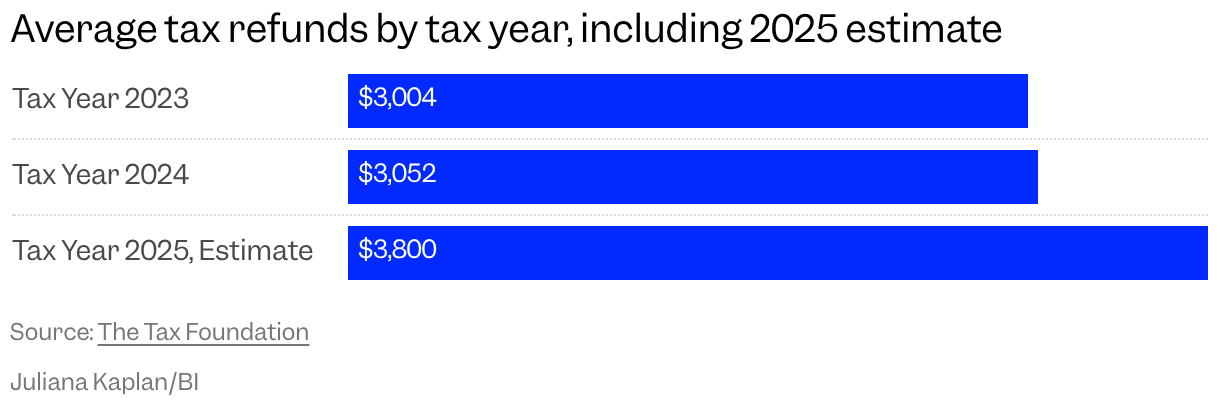
York said that middle- and upper-middle-income filers will be primarily affected by the new tax cuts; the lowest earners already have little tax liability, and the highest earners won't benefit from many of the new provisions targeted at lower earners.
Your age, dependents, and state will also affect how your refund looks. An increased child tax credit will impact parents, while an increase in the cap on how much filers can deduct for state and local taxes could lower tax bills for filers in states like New York and California, where local taxes tend to be higher.
And, of course, new deductions for those who earn tips or receive overtime will apply only to workers who fall into those categories. That's also true of deductions for auto loan interest.
"The average might conceal a lot of variation — where an average taxpayer might see some benefit from that standard increase, maybe the child tax credit increase if they have a qualifying dependent, but otherwise they're not in those other qualifying categories and they only see a slight bump in their refund," Garrett Watson, director of policy analysis at the Tax Foundation, said.
Even so, this year's refund might be larger than what taxpayers can expect going forward. The IRS has updated its withholding tables for tax year 2026, meaning that your paychecks next year will reflect the tax cuts.
"In paychecks that you receive for 2026, it reflects this new tax system with changes to the standard deduction and the child tax credit," York said. "Of course, it's always a good idea to visit your own W-4 and update your withholding information too after maybe things in your life have changed from 2025 to 2026, or you got a bigger refund than anticipated, and you want to make sure your withholding is accurate going forward."