
Getty Images
When Massiel Lugo's parents moved to Jackson Heights, Queens, from the Dominican Republic nearly 50 years ago, the working-class neighborhood was an affordable place to raise a family.
Now that Lugo is in her early 30s and raising her own two kids in the same neighborhood, that's increasingly not the case. Though she took over her aunt's lease and the landlord hasn't raised the rent to market rate, Lugo's approximately $1,700 a month rent still adds up to more than 30% of her income, the threshold at which housing experts generally define housing as unaffordable.
Rents all around her have soared — data from StreetEasy indicates median rent in Jackson Heights rose about 26% between 2020 and 2025 — pushing more households into the rent-burdened category. Lugo worries she'll never be able to afford to move.
"At the end of the day, it's home, but it has changed so much," Lugo said.
A growing share of New Yorkers are struggling to afford life in one of the most expensive cities in the world — and the rising cost of housing is a big part of that. Once-affordable neighborhoods from Sunset Park, Brooklyn, to Jackson Heights, have been gentrified by higher-income newcomers fleeing costlier areas, prompting the question: Who can afford the concrete jungle anymore?
Where NYC rents are sky high
New York City's new mayor, Zohran Mamdani, was elected on a pledge to make the city affordable for working-class New Yorkers again, including by freezing rents on the city's nearly one million rent-stabilized apartments and fast-tracking housing construction on city-owned land.
"As many working people know, it is increasingly impossible to find an affordable home in New York City, to build a dignified life without making hundreds of thousands of dollars a year," Mamdani said during a press conference.
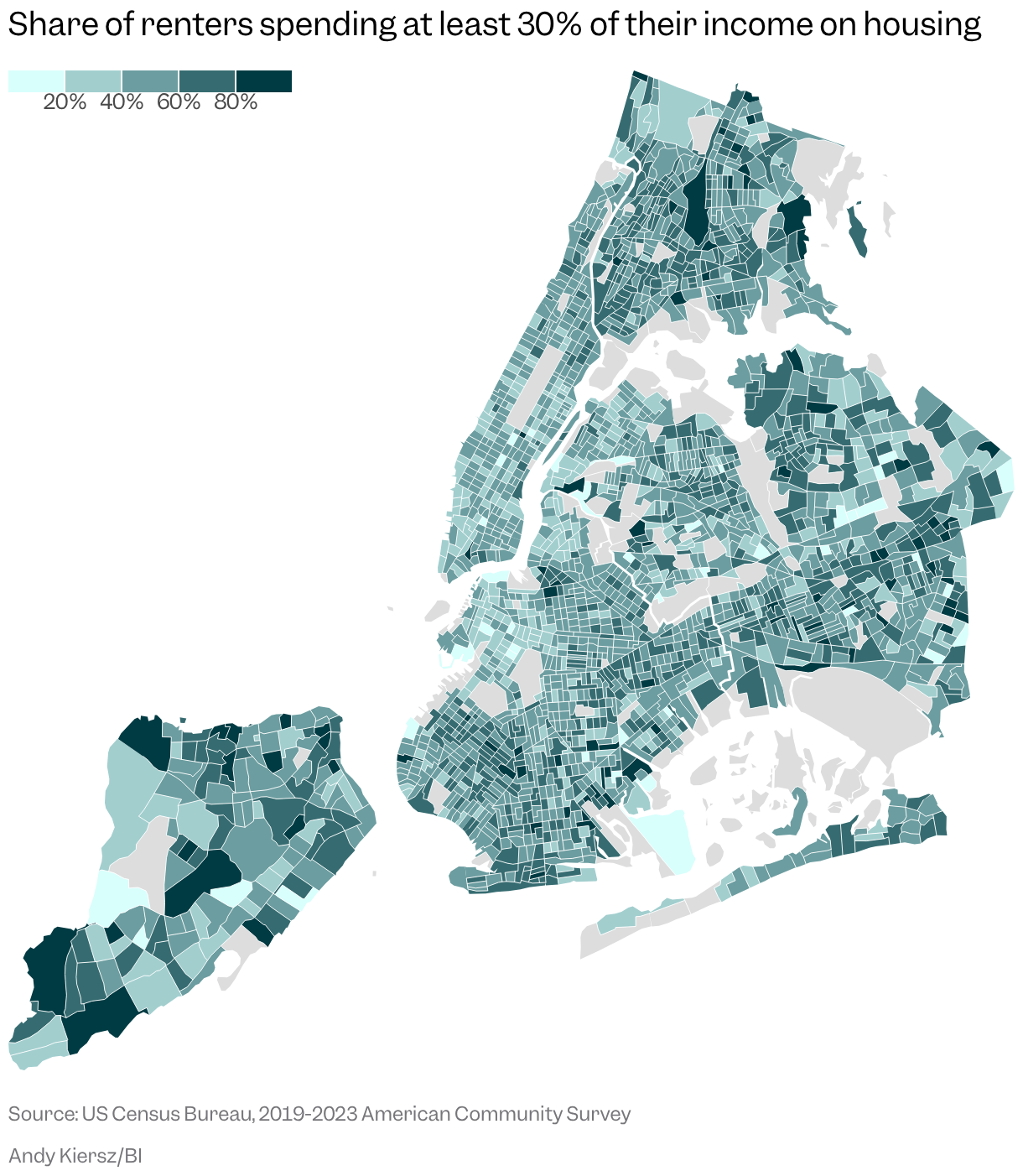
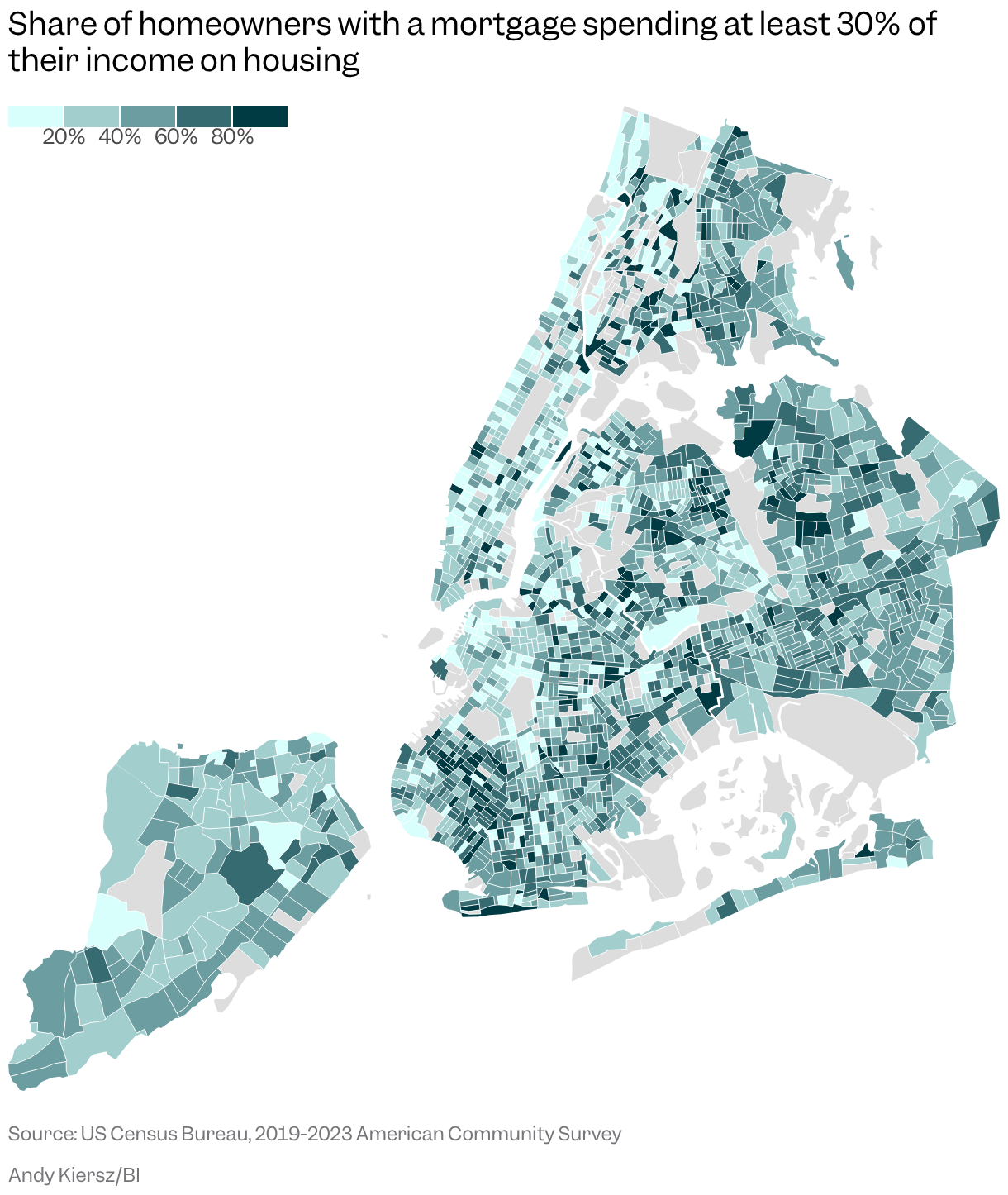
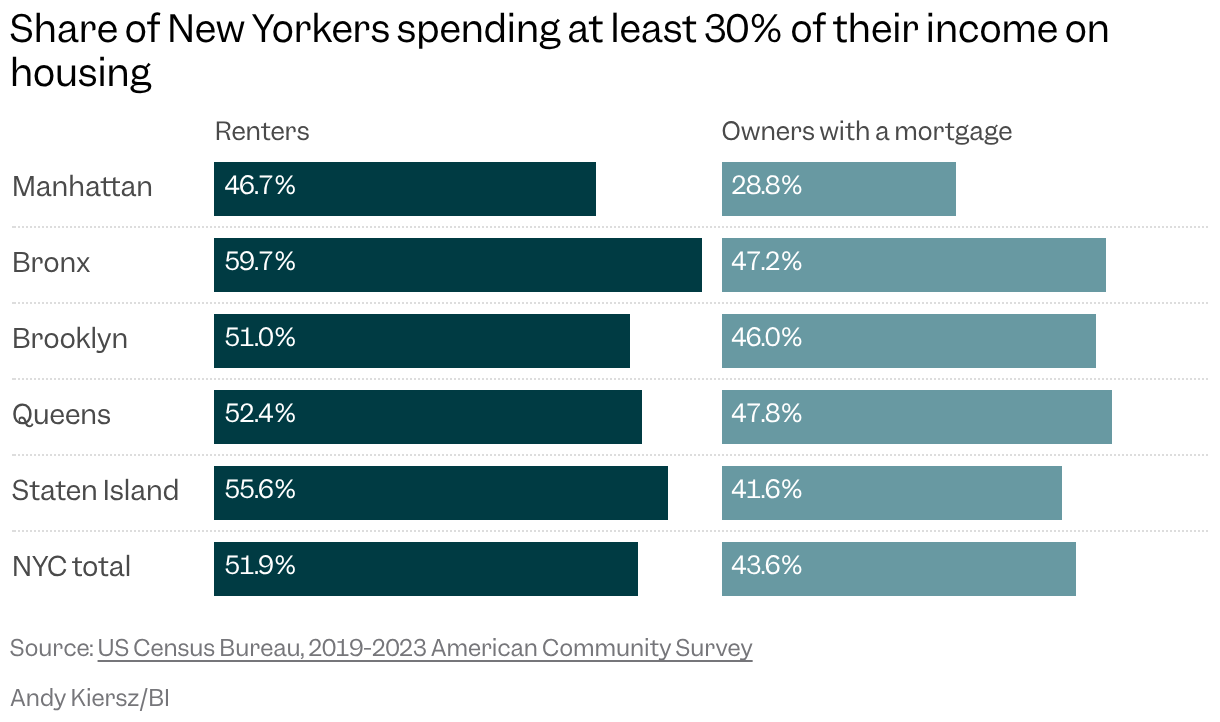
More than half of New York City's tenants are rent-burdened, and nearly 30% of renters fork over more than half their income on housing each month, comparable to the share of cost-burdened renters in the country as a whole. The vast majority of rent-burdened New Yorkers make far less than the median income, but a substantial share of middle- and higher-income renters and homeowners are cost-burdened, too.
Analyzing data from the Census Bureau's 2019-2023 American Community Survey, we found that most New York City neighborhoods have a significant population of both renters and homeowners who are cost-burdened, with that share concentrated in the outer boroughs. Few parts of the city are in the clear.
"A high-income household that's paying 40% of income toward housing probably can still afford medication and afford food," said Emily Goldstein, director of organizing and advocacy at Association for Neighborhood and Housing Development, a coalition of housing groups.
Homebuilding isn't keeping up with the city
For decades, New York City has not built enough new homes, creating a severe shortage that's driven up rents and home prices. Between 2011 and 2023, the city added 895,000 new jobs, but only about 350,000 new homes. The city's housing vacancy rate fell to 1.4% in 2023 — the lowest since 1968 — and far below the widely considered healthy vacancy rate of 5 to 8%.
The housing that's been built in recent years is dominated by higher-end one- and two-bedroom apartments designed for higher earners. While the median renter household in the city makes about $70,000, the median rent citywide is about $4,400 per month, or $52,800 a year — significantly above the recommended 30% of income max spend on housing.
New Yorkers who made the city's average wage of around $88,600 in 2023 could afford less than 5% of rentals on the market that year, according to Streeteasy. Essential workers making typical wages could afford less than 1% of rentals.
Family-sized apartments with two or three bedrooms are especially hard to come by. The cost crisis is pushing many out of the city, particularly families with young children and lower-income Black and Hispanic residents, according to a 2024 study by the Fiscal Policy Institute, a left-leaning think tank. New Yorkers who manage to find larger apartments tend to hang onto them — more than 40% of apartments with three or more bedrooms have been occupied by the same tenants for more than a decade.
Mamdani has made big promises on housing affordability, some of which would require state approval, including freezing rents on rent-stabilized apartments, which have gone up between 2.75% and 3.25% for one-year leases over the last couple years. His campaign also promised that the city government would build 200,000 permanently affordable housing units over 10 years.
Those moves are not without their critics — landlords who own rent-stabilized units are worried about keeping up with their own bills, and building new housing is notoriously difficult in a city where many stakeholders have veto points.
"There's no question that the majority of New Yorkers are struggling with housing costs, and that, especially in the last election, we saw a really clear mandate that voters want the government to do everything in their power to address the cost of living and affordability," said Annemarie Gray, the executive director of Open New York, a nonprofit group that supports housing development, who's also advised Mamdani's team.
Gray said the city needs to add about 500,000 new homes — market-rate and affordable — over the next decade to bring down housing costs. In late 2024, the city enacted a sweeping zoning reform package, known as "City of Yes," designed to pave the way for 80,000 new homes across the city over 15 years. Gray called the potential impact of those reforms "a drop in the bucket."
"There are not nearly enough types of housing of different sizes, of different scales, that are meeting different income levels," Gray said.
The real estate industry is pushing for more subsidies for new housing, continued zoning reforms, and fewer regulations that slow down construction. The Real Estate Board of New York, an industry lobbying and advocacy group, released a report in December that concluded it takes, on average, 3.4 years to build a new apartment building or four years if it's in Manhattan.
"We must strengthen existing financing tools to promote new construction, expand development opportunities through zoning, and streamline the permitting process," said Basha Gerhards, REBNY's executive vice president of public policy.
When affordable housing isn't really affordable
Much of the subsidized affordable housing that's been built in recent years — largely by private developers with government incentives — isn't affordable enough for many lower-income, rent-burdened New Yorkers.
Freezing rents for stabilized units, which are disproportionately home to lower-income New Yorkers, would prevent some New Yorkers from being forced out of their homes because they can't afford rent, advocates say. "At an individual level, freezing rents is actually an eviction prevention approach," Goldstein said.
Lugo wouldn't directly benefit from a rent freeze since her apartment isn't rent-stabilized. She dreams of moving to Bayside, a wealthier, more suburban part of Queens, but housing and transportation costs out there would be even higher. She doesn't think she can find a better deal on any similarly sized apartment in a comparable neighborhood in the city.
For now, she's sticking it out. "I know I am very fortunate with the apartment that I have," she said.