
Maskot/Getty Images
- The Bureau of Labor Statistics classified 206 jobs with very high relative exposure to AI.
- Over 100 of them earned a median pay of at least $75,000 last year, and most are projected to grow.
- Software developers and management analysts are high-paying, booming jobs with very high exposure.
How software developers work has already been transformed by the AI revolution, and they're not the only ones.
The Bureau of Labor Statistics classified how exposed hundreds of jobs are to AI based on various published studies over the past few years.
BLS classified 206 of 831 jobs as very high, with over 100 earning a median annual wage of at least $75,000 last year.
"'Very high' relative AI exposure generally indicates that, compared to other occupations, a larger fraction of an occupation's tasks can be completed or assisted by AI technology, and that LLMs have been observed performing some of the occupation's tasks," BLS said. It doesn't necessarily mean job loss.
Many of these very highly exposed jobs are high-paying and projected to grow, based on new BLS employment projections. Below are 10 high-paying, very highly exposed jobs with the highest projected growth.
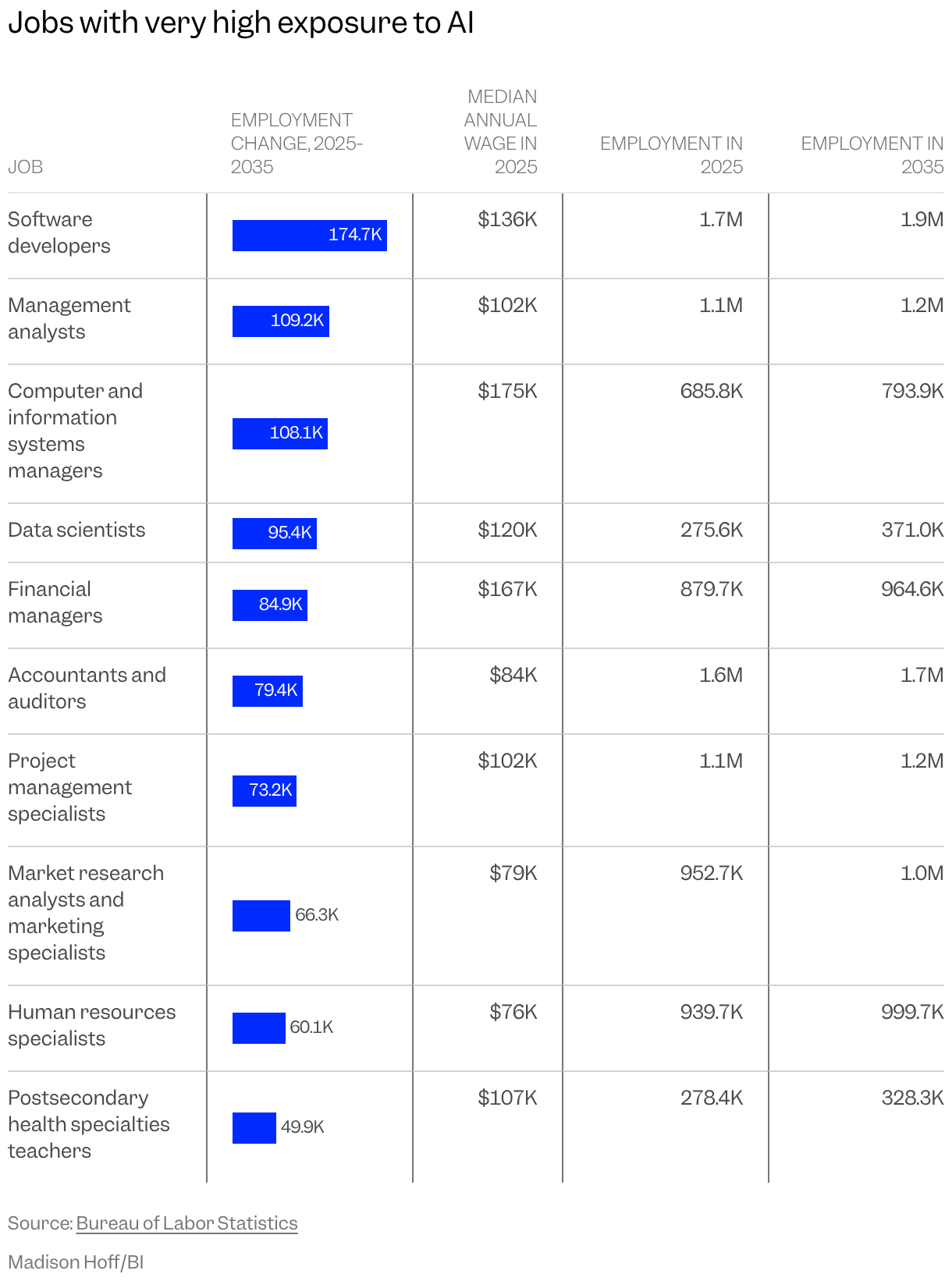
Employment of software developers is projected to increase by about 175,000, reaching about 2 million workers in 2035. Among all jobs, it ranks No. 6 in its projected employment boom over the decade.
"Demand for software developers, software quality assurance analysts, and testers is projected to be strong due to the continued expansion of software development for artificial intelligence (AI), Internet of Things (IoT), robotics, and other automation applications," BLS said.
The bureau added that there could be greater demand for workers to develop security software and to meet the rise in software-based products.
"For example, software systems continue to be built for consumer electronics and other products, including IoT-connected devices and electric vehicles (EVs)," BLS said.
Dan Krzyzanowski previously told Business Insider that he likes that AI eliminates the "boring elements" of software engineering.
"I really appreciate the fact that I can remove the monotony from my day-to-day and focus on creating," Krzyzanowski said.
Proficient programmers still need to know the core elements of coding, including debugging. Krzyzanowski said AI-generated code often needs to be reviewed.
While several tech jobs are high-paying, projected to grow, and very highly exposed to AI, human resources specialists are among the non-tech jobs exposed with very high exposure to AI. They're coming across AI-developed résumés and can use AI to assist in landing new talent, such as to screen job applicants.
Brian Elliott, CEO of think tank and advisory group Work Forward, said in a MIT Sloan Management Review column that chief HR officers are at a fork in the road.
"One path leads to a weakening of the HR role, with more functions automated (like onboarding and learning) or taken on by other business leaders armed with new tools (like skill-based screening during recruitment)," Elliott said. "The other path leads to the kind of evolution that elevates the HR role, with HR not just taking the lead in driving organizational transformation and engagement but taking ownership of the ways in which incoming and current employees interact with AI."
Meanwhile, physician assistants and optometrists are among the high-paying jobs projected to grow over the decade that aren't too exposed to AI relatively.
"'Low' relative AI exposure generally indicates that the requirements of an occupation do not match well with the current capabilities of AI models, and that LLMs have not been observed performing many of the occupation's tasks," BLS said.