
ROBYN BECK/AFP via Getty Images
- North Dakota and Nevada lag badly on permits, trailing projected new household growth
- UNLV Lied Center report finds US permits outpace demand, but some states risk affordability
- Nevada construction defect law deters condos and multifamily homes, shrinking affordable supply
Some states are falling behind on housing — and two are set to build fewer homes than the projected number of new households.
Nationally, states are permitting an average of 1.7 homes for every projected new household — about 121,000 homes a month, compared with 72,000 projected new households, according to an October research report from the Lied Center for Real Estate at the University of Nevada, Las Vegas.
Yet, a few states are lagging behind, and they could face affordability concerns with supply falling short of future demand and pushing prices up.
"The states that aren't doing well are the states that have other issues working against them," said Nicholas Irwin, coauthor of the report and research director at the Lied Center for Real Estate. This could be due to a lack of building incentives, high construction costs, and limited land availability in those states.
Here are the states with the largest shortfalls between monthly permit pace and projected household growth across the US.
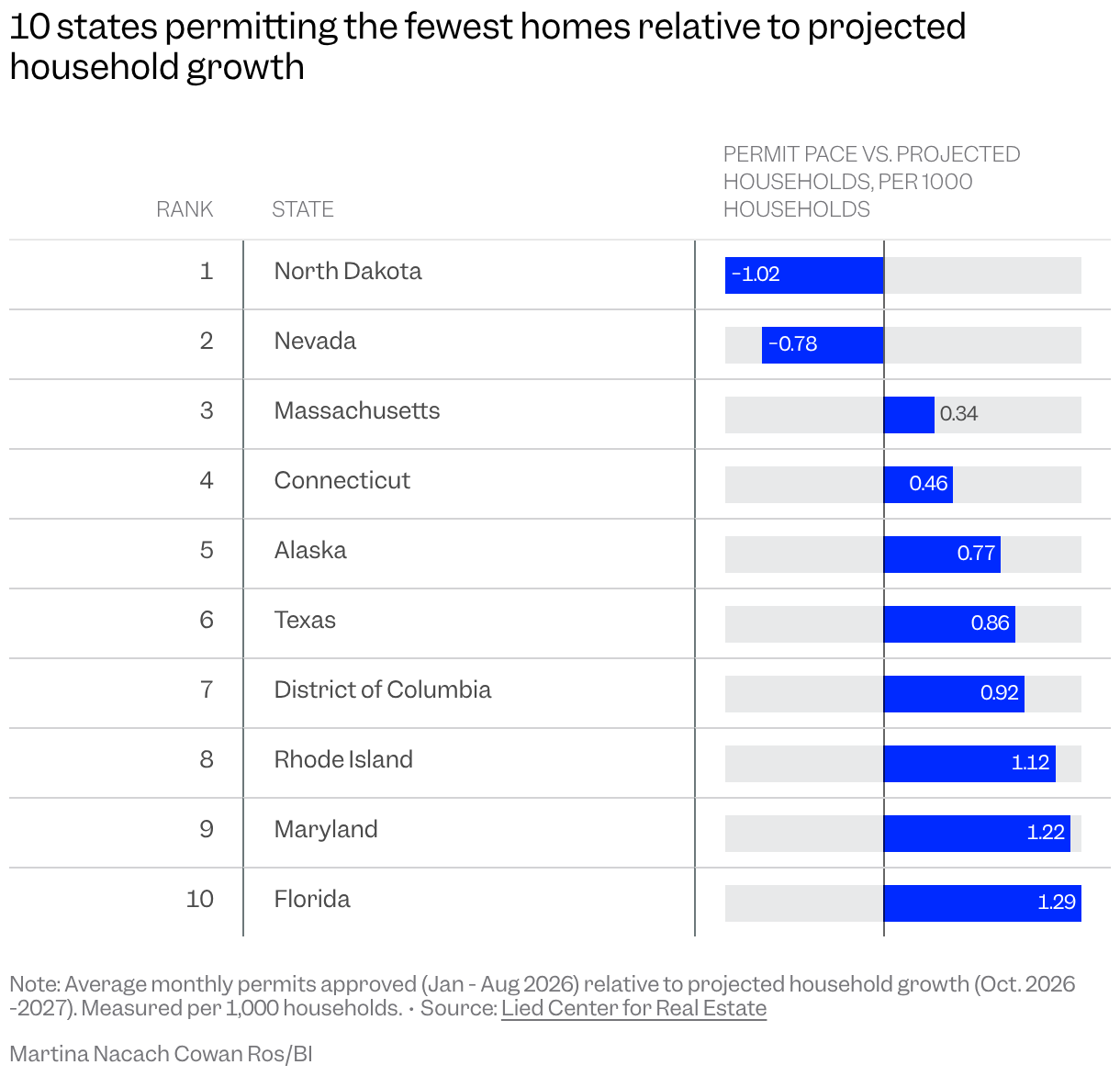
North Dakota and Nevada are the only two states in the US that have fewer than 1 permitted unit per projected household. North Dakota is 45 permits short of its projected new households a month, and Nevada is 122 permits short of its projected new households a month.
In the report's overall housing supply pipeline rankings, North Dakota ranked 48th nationally, indicating struggles across the board and poor performance on four metrics, including the building permit rate per projected household. The number of units permitted per resident in North Dakota is already 30% lower than the national average, and its number of permits issued per cost-burdened household is 12% lower than the national average.
Second-to-last was Nevada. As in North Dakota, there is less permitted new housing than the number of projected new households from October 2026 to December 2027. Irwin said there are a few reasons Nevada faces this issue, one of which is state policy that disincentivizes construction.
For example, in Nevada, the Construction Defect Law allows builders to be held liable for construction defects for up to 10 years after the project is completed. The law disincentivizes developers from building condos and multifamily homes, where there is more room for construction defects to affect multiple buyers and prompt lawsuits — pushing developers toward building single-family homes and away from affordable housing options, Irwin said.
"Everyone responds to incentives, and developers are no different," he said.
Lower approval of building permits per projected households will directly impact states already experiencing affordability concerns, which often need more housing.
"The issue is for the states that already have affordability issues; they need to build well above that pace," Irwin said. "They need to be building, for every one anticipated household, they're building two housing units. That will start to put more downward pressure on prices in the future because you're starting to bend that supply curve."