
Philip Dulian/picture alliance via Getty Images
- Google AI Overviews are 44% more likely to be negative about brands than ChatGPT is, a new BrightEdge report found.
- A version of this post appears in the CMO Insider newsletter.
- You can sign up for Business Insider's weekly marketing newsletter here.
Keep an eye on those AI chatbots and answer engines. They might be talking smack about your brand behind your back.
Newly released research from BrightEdge found that Google's AI Overviews were 44% more likely to display negative sentiment toward a brand in their answers than OpenAI's ChatGPT was. BrightEdge, a search engine optimization company, said it analyzed hundreds of millions of prompts and millions of queries, searches, and digital data points from mid-January through February 2026.
The majority of AI brand mentions BrightEdge observed were either positive or neutral. However, the scale of both platforms means that the 2.3% of brand mentions that skewed negative on Google, and the 1.6% on ChatGPT, could be seen by millions of users in a month, BrightEdge said.
"The first thing we saw that was different from classic search versus AI is that it has an opinion," BrightEdge CEO Jim Yu told Business Insider in an interview. "It fundamentally changes marketing."
A Google spokesperson said the report used "a flawed methodology to make sensational claims."
"In any case, the difference in sentiment the study found is less than a single percentage point," the spokesperson said. "AI Overviews are based on web content, and reflect what sources on the web say about a topic."
OpenAI didn't respond to a request for comment.
As AI chatbots shift the way people research products and services online, brands are turning to new techniques — known as generative engine optimization (GEO) or answer engine optimization (AEO) — to ensure they show up prominently and accurately inside platforms.
It's a fast-changing space as models are constantly trained and updated, meaning many companies are still scrambling to figure out what their GEO strategies should look like.
Where and when Google and ChatGPT share their opinions
Google was more likely to be critical of brands in the wake of recent news events and controversies.
ChatGPT had a lower rate of overall negativity toward brands, but it clustered around the times when users were evaluating different products, and when they might be close to making a purchase.
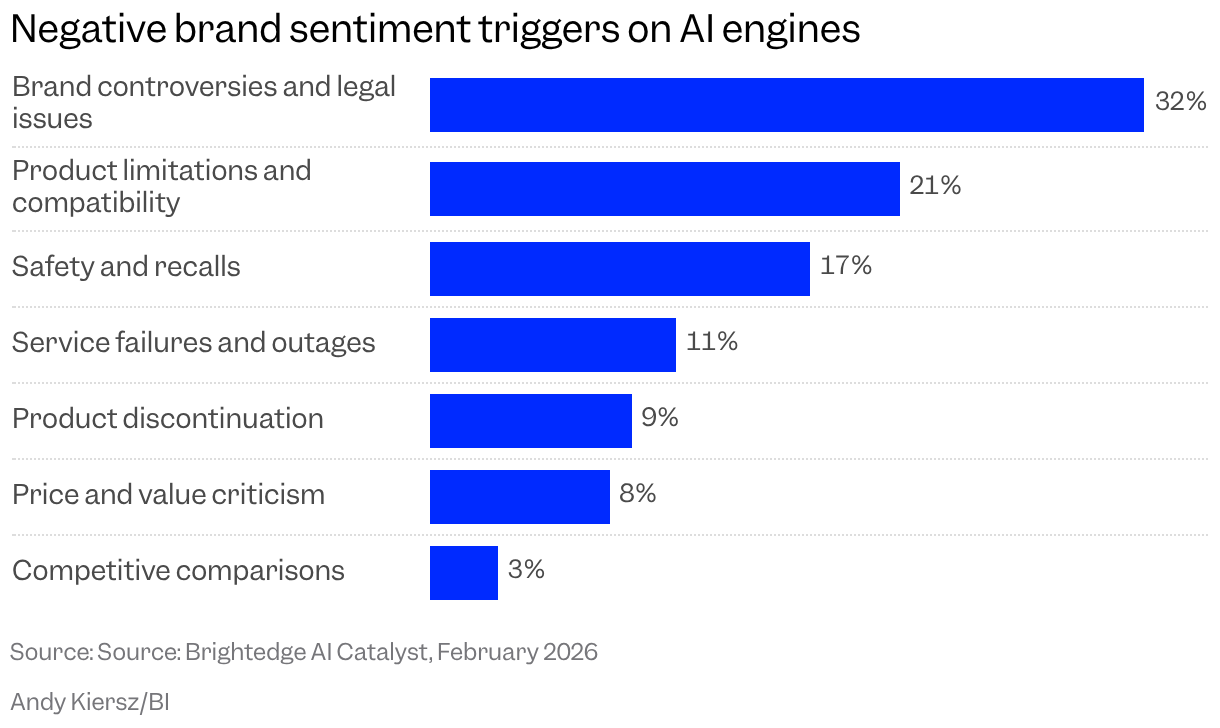
Across all industries, brand controversies and legal issues were the leading triggers (at 32%) of negative brand sentiment on both platforms, according to BrightEdge. Other factors that could lead to negative responses included information about the limitations of a brand's products (21%), recent safety or recall concerns (17%), and service failures or outages (11%).
Even dated negative news stories and past customer feedback can influence AI responses, Yu said. For that reason, Yu said companies should maintain a steady cadence of new content because "AI loves to find the most recent information."
Yu added that brands should consider motivating customers to leave positive reviews, though he emphasized that there's not a "one size fits all" approach for businesses. Marketers should analyze the most common sources AI engines are citing and work backward from there, Yu said.
"It's not, hey, let's just go do a bunch of Reddit," Yu said. "It's pinpointing what matters."